Cambridge Animation Festival
1965 to 1998.
The Cambridge Animation Festival was Britain's first animation festival, started by Dick Arnall in 1965 while he was still an undergraduate at Queens’ College, Cambridge. Over the next four years it brought international and experimental animation to a British audience, under a name chosen to say that animation was an art and not only cartoons for children. It collapsed in 1969, came back in 1979, and ran until 1998, moving to Bristol and then Cardiff as it grew.
1965: the British Animation Festival
Dick came up to Queens' College in 1963 to read natural sciences and ran the university film society. In November 1965 the society and the Cambridge Animation Group, founded by the student and future animator Alan Kitching, put on the British Animation Festival: an exhibition of stills and artwork in the North Room at Queens', and screenings and a symposium in the Lady Mitchell Hall, from to . The poster promised Bob Godfrey, Dick Williams, George Dunning and Halas and Batchelor.
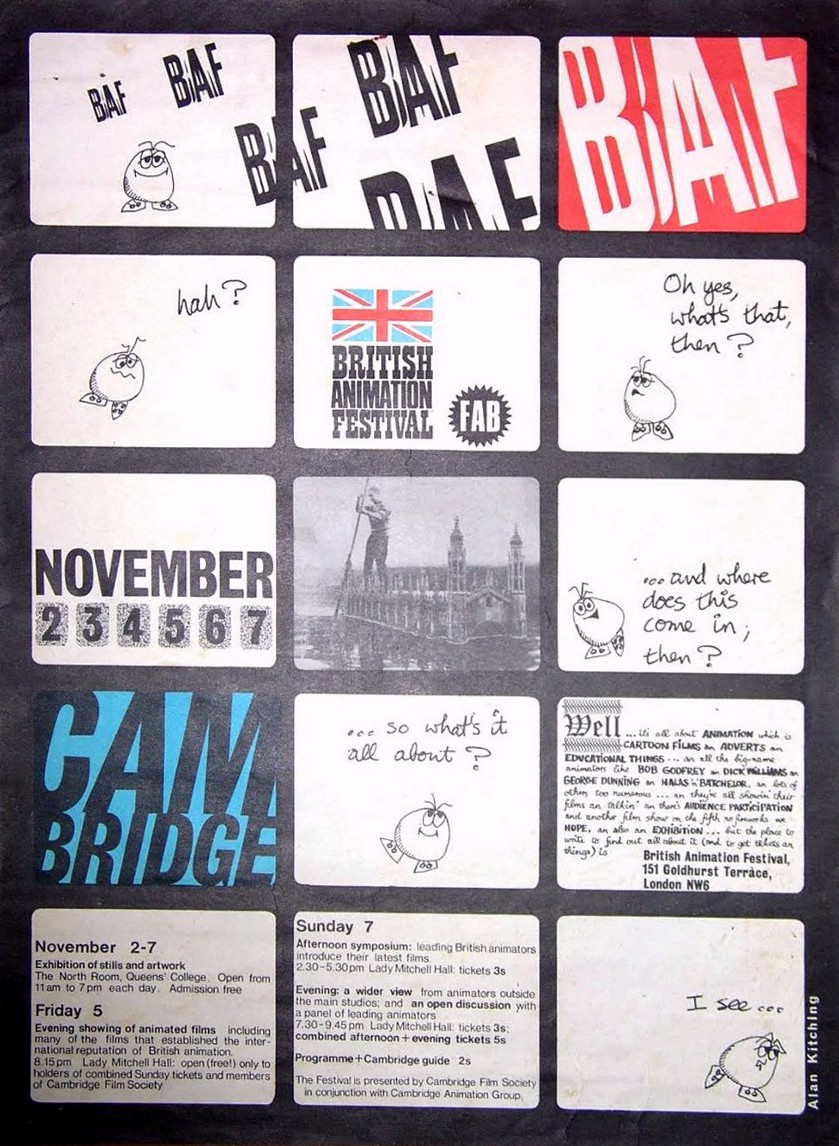
Writing in 1984, the animation historian Ken Clark gave “the honour and credit for organising the Festival” to “an amiable and persuasive young man, Richard (Dick) Arnall”, who “held the passionate belief that public awareness of British animation needed a sharp shake” (Animator, Summer 1984).
1966: Hitchcock at the film society
As president of the film society, Dick had the idea of inviting Alfred Hitchcock to Cambridge, and on he came. Anglia Television filmed him arriving at King’s College in a Rolls-Royce Silver Cloud, being greeted, and talking about his career and his new film, Torn Curtain. He gave a question-and-answer session in the Lady Mitchell Hall and showed his favourite of his own films, Shadow of a Doubt.
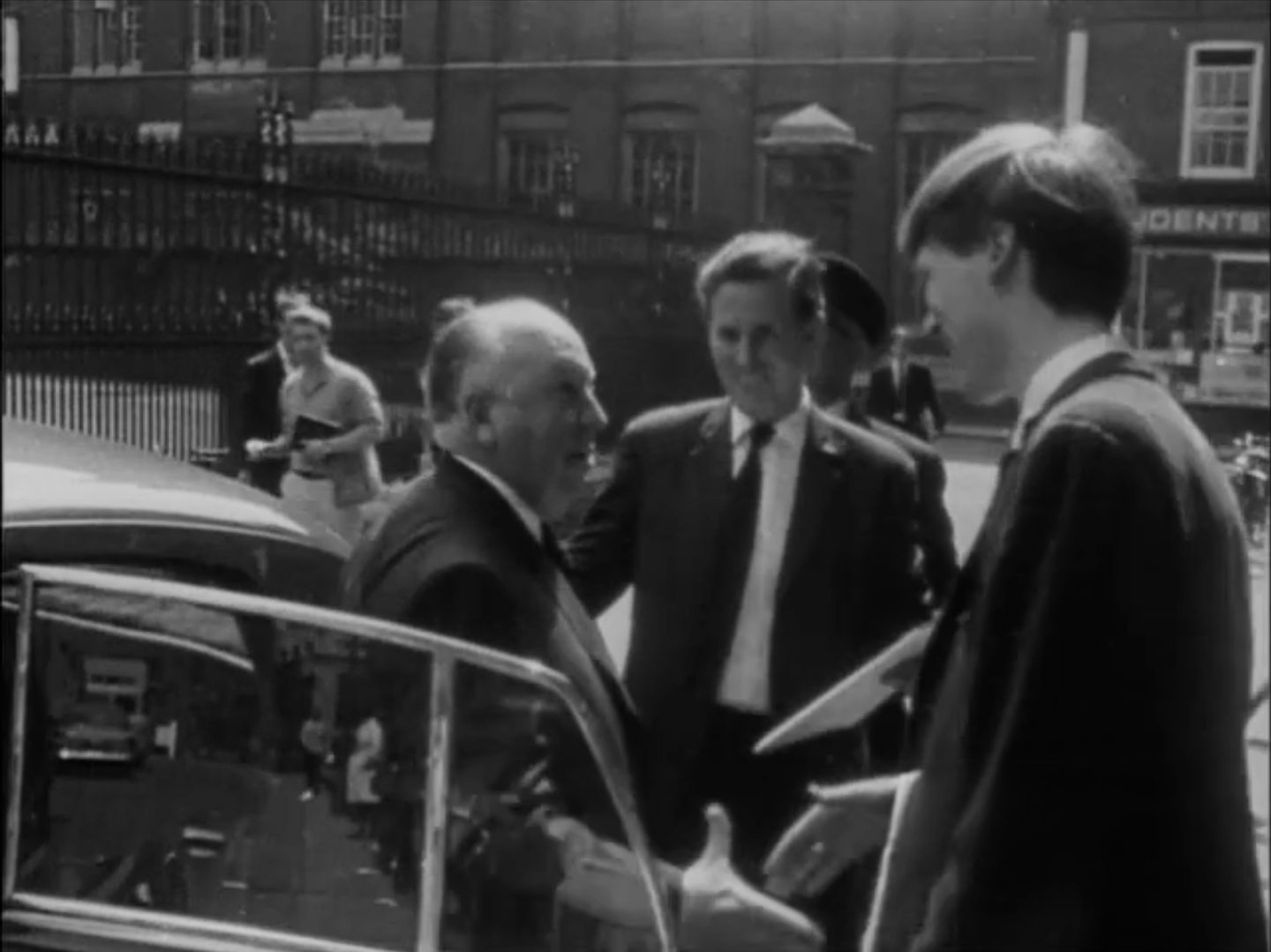
The playwright David Hare, then 19, remembered that Hitchcock arrived five hours early, so a few students spent the afternoon with him eating cold roast beef and baked potatoes and asking him anything they liked. Christopher Frayling, a second-year undergraduate, met him after the talk. The photographer Dick hired for the day, Peter Dunne, took the portrait of Hitchcock that Apple later used in Think Different.
1967: the first Cambridge Animation Festival
The first Cambridge Animation Festival ran from to , with an office in the Corn Exchange. The city put up £2,500 and the British Film Institute gave practical help. There were no prizes. Guests included Bob Godfrey, George Dunning, animators from Yugoslavia and Adrienne Mancia of the Museum of Modern Art in New York. The programme included a retrospective of the Zagreb studio, which Dick wrote about for The Times the following summer, films by Alexandre Alexeieff, a session on animation in education and Walerian Borowczyk’s feature Theatre of Mr and Mrs Kabal.
“The festival is really the brainchild of its director, Richard Arnall: two years ago, while still an undergraduate, he organized a little pilot festival sponsored by the Cambridge Film Society.” The Times, 1 November 1967
Dick chose the name with care:
“I very deliberately called the event the Cambridge Animation Festival. I wanted to signpost a defiance of Disney’s cultural hegemony and challenge the prevailing popular presumption of funny, gag-rich cartoons for kids.” Dick Arnall, Death to Animation, 2005
1968: the second festival
The second festival ran for four days in November 1968: about 115 short films and three features, the best of the year alongside a retrospective, Forty Years of French Animation, with midnight screenings of the Hubleys’ Of Stars and Men and Yellow Submarine. Len Lye came from New York to speak, and the documentary film-maker Edgar Anstey lectured on animation in industry. The films included Norman McLaren’s Pas de deux, John Hubley’s Windy Day, Halas and Batchelor’s The Question and Bob Godfrey’s Two Off the Cuff. Every programme opened with the festival’s own film, Cambridge Steam-Engine, made by Charlie Jenkins and Heinz Edelmann of Yellow Submarine; the BFI has it online.
“Now in its second year, the Cambridge Festival seems established as an annual event, provided the City Corporation continues to support it and Dick Arnall to act as organizer.” Ralph Stephenson, The Times, 12 November 1968
“All credit to Richard Arnall, the Festival Director, who selected the wide-ranging programme and under whose aegis the Festival is hopefully here to stay.” Patrick Eason, Sight and Sound, Winter 1968/69
“By far the most original, exciting and creative film festival ever staged in the British Isles.” The International Film Guide, 1968
1969: the festival cancelled
The third festival was to be the World Festival of Animation Cinema, with a retrospective of thirty years of Czech puppet, cartoon and experimental film. Dick later said Cambridge had been chosen to stand in for Annecy, abandoned in the upheavals of 1968, and the first congress of ASIFA, the international animators’ association, was to meet there at the same time. It never happened. The money for shipping films was withdrawn, the Foreign Office refused the fares of the East European guests, and the city council changed the chairman of its committee three times in a few months. Dick withdrew in August 1969.
“The main fault seems to lie with Cambridge City Council.” Cinema, Cambridge, October 1969
In Dick’s own account, the city “refused to accept the very substantial sponsorship that I had been able to raise within the film industry”, and he resigned. The Times reported that the council “cancelled the festival at the eleventh hour”, and the ASIFA congress moved to London. A London film magazine later wrote of “the unhappy demise of the Dick Arnall Show at Cambridge”.
1979 to 1998: the revival, and what came after
The festival came back in 1979 and ran, every other year, for almost twenty more years. It stayed non-competitive and built each edition around themes, and it moved city twice as it outgrew its venues. Irene Kotlarz, its director from 1985, has written its history.
Cambridge, 1979 to 1985. John Cannon, film officer for the regional arts association, brought together a group that included Dick, Bob Godfrey, Clare Kitson and the BBC’s Richard Evans, with Antoinette Moses as director. The 1979 festival, from to at the Arts Cinema, showed about 200 films, including the first comprehensive retrospective of British animation, from 1895 to the present. In 1981, with themes of jazz and computer animation, Jeremy Isaacs and Paul Bonner came from the not-yet-launched Channel 4, took a page in the catalogue and gave £20,000, double the festival’s budget; at a reception there Isaacs met Peter Lord and David Sproxton of Aardman. Channel 4 sponsored the festival from then on. The 1983 festival, on Animation and Persuasion, showed nearly 250 films, with a Robert Breer exhibition and the British premiere of Marcell Jankovics’s Son of the White Mare. In 1985, under Kotlarz, the theme was storytelling and Chuck Jones was guest of honour, with Raymond Briggs showing work in progress on When the Wind Blows.
Bristol, 1987 and 1989. As the Bristol Animation Festival, “formerly the Cambridge Animation Festival”, it moved to the Watershed and the Arnolfini. In 1987 there were retrospectives of the Brothers Quay and Len Lye, sequences from Jan Švankmajer’s Alice and Yuri Norstein’s The Overcoat, with Norstein on his first visit to Britain, and Robert Breer gave the first Norman McLaren Memorial Lecture. Marjut Rimminen, Dick’s wife, taught a class in the same room, encouraging her students “to work with feelings”. In 1989 the theme was Tricks of the Trade, with John Lasseter among the invited guests, and on Nick Park’s A Grand Day Out, the first Wallace and Gromit film, had its first public showing there.
Cardiff, 1992 to 1998. Wooed to larger premises, the International Animation Festival moved to St David’s Hall in Cardiff in March 1992, under the theme Rocking the Boat. It was directed by Jayne Pilling in 1994 and Fran Barlow in 1996, and renamed Vital! for its last edition in June 1998, directed by Jane Williams. Losses from that edition, about £25,000, closed the organisation in the autumn of 1998.
What it started carried on. Jayne Pilling, who directed the 1994 festival, went on to run the British Animation Awards until 2018. The Watershed and the Arnolfini, its home in Bristol, are now the main venues of Encounters, whose Animated Encounters festival began in the city in 2001. And Cardiff has an animation festival again, the Cardiff Animation Festival, founded in 2018.
Archives and further reading
The festival papers are in the Dick Arnall Animation Archive at the University for the Creative Arts. Programmes for the later festivals are in the British Artists’ Film and Video Study Collection at the University of the Arts London, for 1983, 1985, Bristol 1987, Cardiff 1994, 1996 and 1998, and in John Canemaker’s papers at New York University. The Cambridge University Film Society’s own papers, with photographs of Hitchcock’s visit, are at Cambridge University Library.
Clare Kitson’s British Animation: The Channel 4 Factor (2008) tells how the revived festival met Channel 4. The Lost Continent collects the early press coverage, and the archive of Animator magazine has reports on the 1980s festivals.
Poster © Alan Kitching, CC BY-SA 3.0, cropped and straightened. Sources: Alan Kitching’s poster, 1965; East Anglian Film Archive, catalogue no. 99460; Variety, 18 October 1967; The Times, 1 November 1967, 15 July 1968, 12 November 1968 and 29 October 1969 (subscribers); Patrick Eason, Sight and Sound, Winter 1968/69; Cinema no. 4, October 1969; Films and Filming vol. 17 no. 3; Arts Review, 11 May 1979; Back Stage, 23 October 1981; Ken Clark, Animator no. 9 and no. 10, 1984; Animator no. 6, 7, 15, 25, 26 and 30, 1983–1993; James Leahy, Sight and Sound, Winter 1987/88; Animation World Magazine, August and October 1998; Irene Kotlarz, Animation World Network, 1999; Dick Arnall, Death to Animation, 2005; Aurora 2007 catalogue; Clare Kitson, British Animation: The Channel 4 Factor, 2008; Christopher Frayling, The Guardian, 7 January 2018; David Hare, New Statesman, 6 December 2018, and The Blue Touch Paper, 2015.